Exclusivity is no longer defined simply by the hotel or the price of the room. Increasingly, it means having space, privacy and the freedom to experience a place on your own terms, before it becomes another familiar backdrop on social media. It also means travelling somewhere where nature is part of the experience, not simply the view from the hotel.
Africa is home to countless places that offer exactly that. Remote peninsulas with no road access, tiny islands with only a handful of places to stay, and pristine beaches protected within marine reserves. These destinations are not replicas of the Maldives, Bali or tulum. They offer many of the same qualities, from seclusion to wildlife and small-scale accommodation, without the same crowds or familiarity.
For this index, we assessed 19 African coastal and island destinations to identify the strongest alternatives to some of the world's best-known beach escapes.
How We Created the Index
How We Created the Index
The ranking is based on five key metrics. Some measure the quality of the experience itself, while others consider the practical realities of travelling there from Spain.
Privacy
We assessed the size and style of accommodation, visitor numbers and each destination’s level of isolation. A coastline lined with dozens of large resorts, for example, cannot offer the same sense of exclusivity as a remote peninsula with just 24 villas and carefully managed access.
Emerging Appeal
To understand which destinations remain genuinely under the radar, we analysed search demand in Spain and globally, together with each destination’s visibility across social media platforms.
Nature
Not every beach offers the same natural surroundings. We considered the presence of marine reserves, national parks, coral reefs, forests and wildlife, alongside the experiences they enable, including diving, whale watching and turtle encounters.
Personalisation
We also examined how easily each destination can be tailored to individual travellers. Private villas, boutique lodges and the flexibility to customise itineraries, excursions and transfers all contributed to the final score.
Accessibility & Value for Money
Finally, we assessed flights from Madrid, total travel time, additional transfers and the approximate cost of a seven-night stay.
This creates something of a natural paradox. The world’s most remote destinations are often the most time-consuming and expensive to reach, yet that very remoteness is a large part of their appeal. For this reason, privacy and accessibility were treated as separate criteria: one measures exclusivity, while the other reflects how practical the journey is from Spain.
What We Discovered
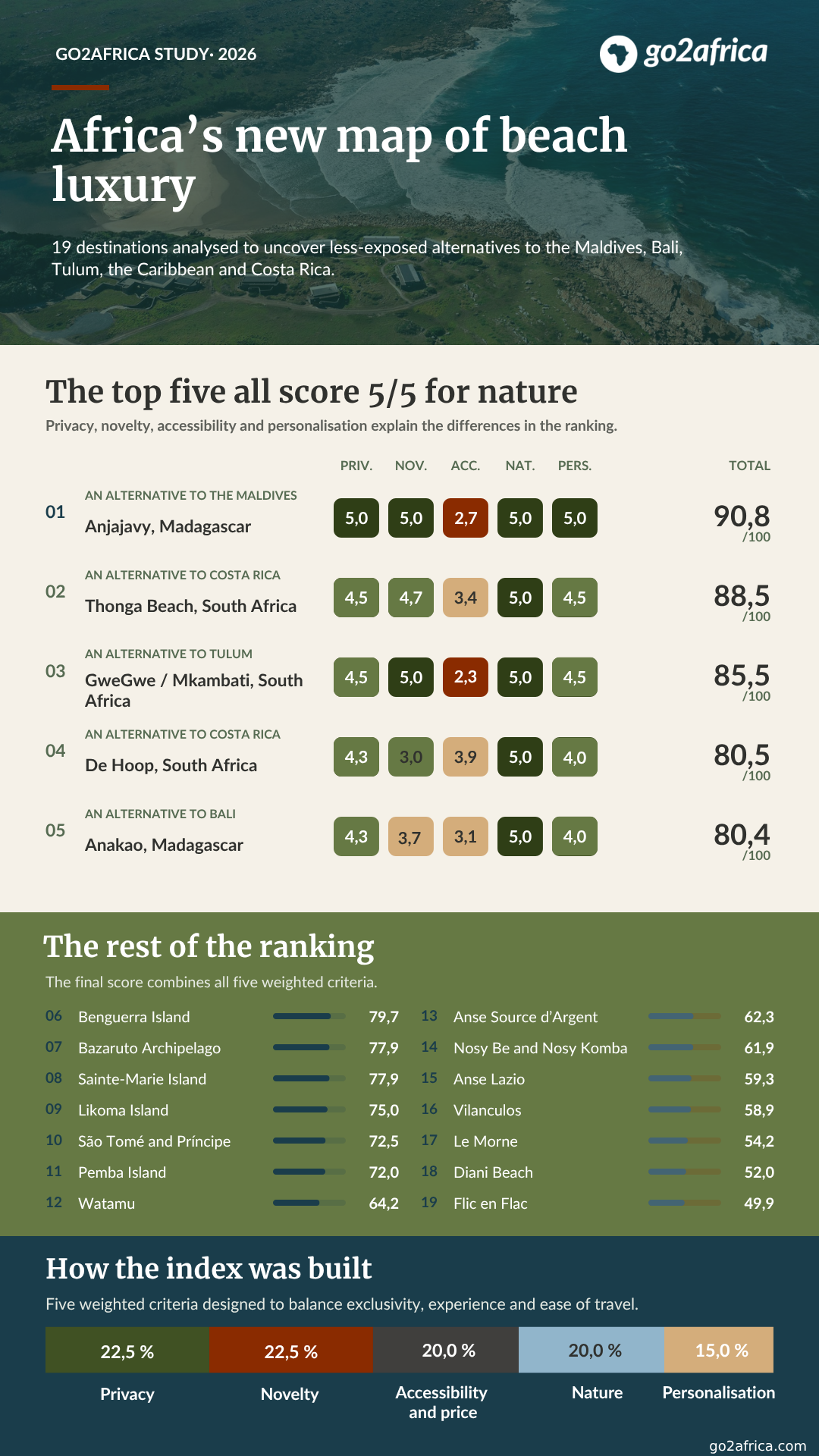
Anjajavy, Madagascar, takes first place with an overall score of 90.8 out of 100. Home to just 24 villas, the peninsula is inaccessible by road and combines pristine coastline, dry forest and an extensive private nature reserve.
The remaining top positions are occupied by Thonga Beach, GweGwe, De Hoop Nature Reserve and Anakao. While South Africa’s beaches claim three of the top four destinations, those looking for compelling reasons to visit Madagascar will note that the island nation makes a strong showing, appearing twice within the overall top five.
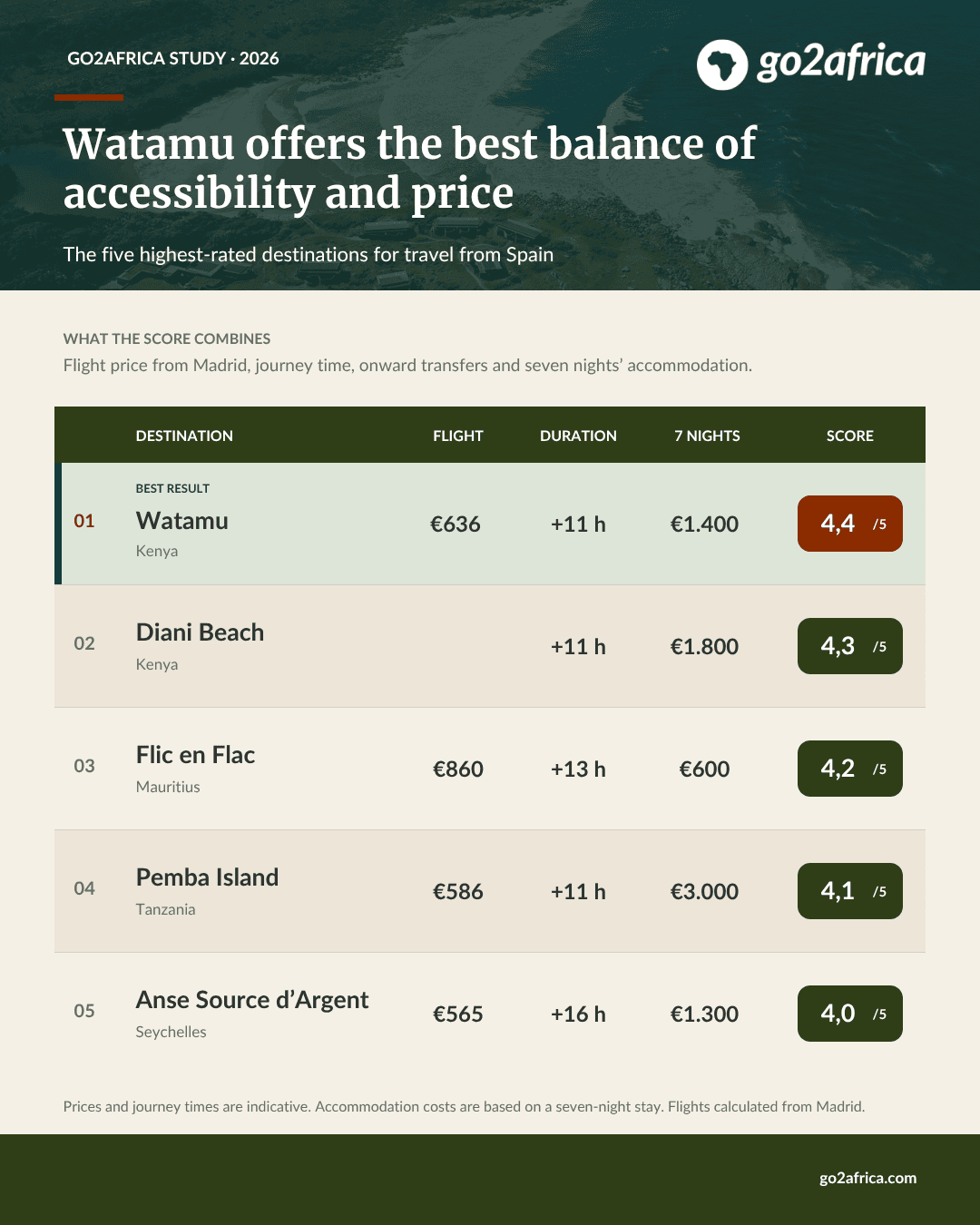
Watamu, Kenya, ranks as the most accessible and best-value destination in the index. Based on our benchmark journey from Madrid, flights start from around €636, total travel time is just over 11 hours, and a seven-night stay costs approximately €1,400.
For travellers seeking an alternative to Bali, Anakao and Sainte-Marie Island offer the closest match. Those dreaming of the privacy associated with the Maldives should look towards Anjajavy or Mozambique’s Bazaruto Archipelago.
São Tomé & Príncipe emerges as Africa’s answer to the Caribbean, while GweGwe captures much of the spirit that originally made Tulum so appealing. For travellers inspired by Costa Rica, Thonga Beach stands out thanks to its combination of protected coastline, lush vegetation and abundant wildlife.
If the goal is to combine a safari with time on the beach, Kenya’s Diani Beach offers the most practical option. Thonga Beach, while more remote, delivers a far greater sense of privacy and exclusivity.
The overall winner also depends on which qualities matter most. Anjajavy ranks highest for privacy, shares first place for emerging appeal with GweGwe, and ties with Benguerra Island and the Bazaruto Archipelago for personalisation.
Top 5 Dupes
The Five Beach Destination Dupes That Best Represent Africa’s New Luxury
The index does not simply reward the world’s most famous beaches or the easiest destinations to reach. Instead, the highest-ranked locations are remote peninsulas, protected reserves and low-density lodges where exclusivity comes from everything that hasn’t arrived: the crowds, large-scale developments and endless social media exposure.
While all five destinations combine remarkable privacy with exceptional natural surroundings, each offers a different alternative to one of the world’s most iconic beach destinations.
Anjajavy, Madagascar: A Wilder Alternative to the Maldives—Without a Road in Sight
Dinner on the beach.
With 90.8 points out of 100, Anjajavy tops the index. It achieves the highest possible score in four of the five categories assessed: privacy, emerging appeal, nature and personalisation.
At first glance, its turquoise waters, white-sand beaches and beachfront villas recall the Maldives. Beyond the beach, however, dry forests, mangroves, towering baobabs and dramatic limestone tsingy give Anjajavy a character entirely of its own.
It’s remoteness is more than just a marketing claim. No roads lead to the peninsula. Travellers must fly by private charter from Antananarivo for approximately one hour and forty minutes before completing the final leg through the forest. Once there, accommodation is limited to just 24 beachfront villas, spread across seven secluded coves along 3.5 kilometres of coastline. This combination of extremely limited capacity and challenging access explains its outstanding scores for both privacy and emerging appeal.
Anjajavy borders a 1,030-hectare private reserve, while also helping to protect a further 9,773 hectares of surrounding wilderness. The reserve is home to six species of lemur, more than 134 bird species and around 40 reptiles and amphibians. Its beaches also provide nesting grounds for marine turtles, making biodiversity one of the destination’s defining strengths.
Experiences can be tailored almost entirely to individual travellers, from private guides and boat excursions to secluded beach picnics, candlelit dinners and nights beneath the stars. Personalisation extends well beyond accommodation, shaping every aspect of how visitors explore both the coastline and the reserve.
Its greatest drawbacks are cost and travel time. Reaching Anjajavy from Madrid requires more than 18 hours of travel, while a seven-night stay costs approximately €4,970.
Thonga Beach, South Africa: A Costa Rica Alternative with Just 12 Oceanfront Suites
Rock pools and beach.
With 88.5 points out of 100, Thonga Beach ranks second overall. Its strongest scores come in the categories of nature, privacy and emerging appeal. Untouched beaches, coastal forests and vibrant coral reefs combine to create an experience reminiscent of Costa Rica, but in a setting that feels considerably more intimate and far less discovered.
Thonga Beach Lodge is located on the remote shores of Mabibi Beach within iSimangaliso Wetland Park, a UNESCO World Heritage Site. The lodge has just 12 secluded suites, carefully positioned among the coastal forest to maximise privacy. Reaching the lodge requires some patience: the final stretch from Sodwana Bay takes approximately one hour by 4×4 along sandy tracks, but this limited access helps keep the area secluded.
Much of Thonga’s appeal lies beneath the surface of the ocean. Its coral reefs support around 1,250 species of fish, while whales, dolphins and turtles can often be spotted from the shoreline. Between November and February, guests can join guided evening excursions to witness loggerhead and leatherback turtles nesting on the beach, or, a few weeks later, watch hatchlings make their first journey to the sea.
Visitors can also snorkel over pristine reefs, kayak on nearby Lake Sibaya, hike through indigenous forest or enjoy exceptional birdwatching, with more than 440 bird species recorded in the surrounding area.
According to the index, travelling from Madrid takes more than 18 hours, while seven nights of accommodation cost approximately €2,500
GweGwe, Mkambati Nature Reserve, South Africa: The Tulum of Twenty Years Ago
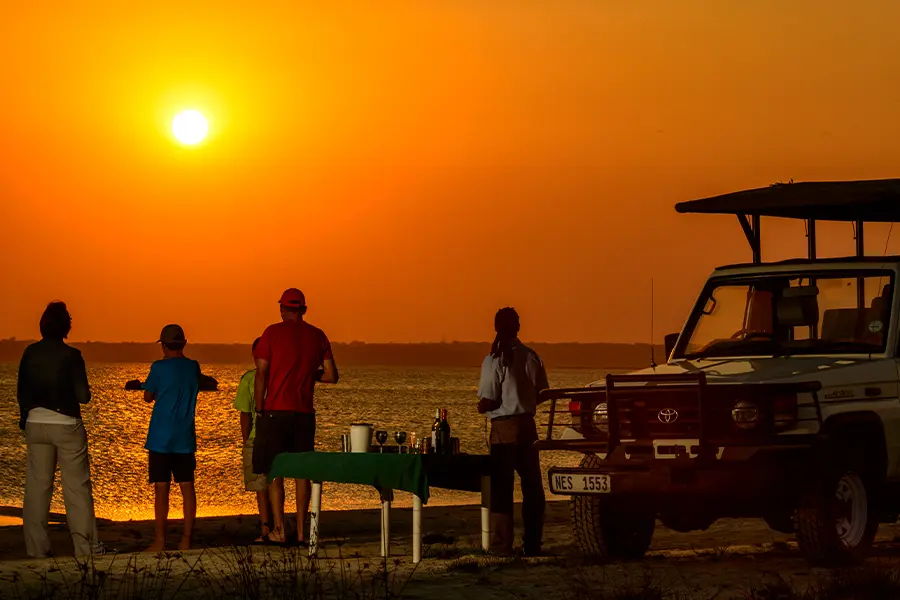
Sundowners at the lake
GweGwe takes third place with an overall score of 85.5 out of 100, achieving perfect marks for both nature and emerging appeal.
It recalls the version of Tulum that first captured travellers’ imaginations, before beach clubs, large-scale development and social media transformed it into a global hotspot. Instead of polished luxury and crowded coastlines, GweGwe offers untouched beaches, boutique accommodation and a far more authentic connection with nature.
Located within Mkambati Nature Reserve on South Africa’s Wild Coast, the reserve protects approximately 7,700 hectares of grasslands, forests, rivers, cliffs and deserted beaches. Within this landscape, GweGwe occupies a private 5,000-hectare concession and features just nine ocean-facing suites,seven double suites and two family suites.
What truly distinguishes GweGwe is the diversity of its landscapes and wildlife. Zebra and antelope graze close to the shoreline, dolphins play in the surf, and humpback whales migrate just offshore. The reserve is also home to 21 waterfalls, including the spectacular Mkambati Falls, which cascade directly into the Indian Ocean.
Guests can explore the reserve on foot, by mountain bike or 4×4, enjoy kayaking and snorkelling, or join marine excursions to spot whales and dolphins.
Its remoteness comes at a price. The journey from Madrid exceeds 21 hours, making it the longest journey included in the study. Flights cost approximately €1,050, while seven nights of accommodation are around €5,000.
De Hoop Nature Reserve, South Africa: A Different Kind of Costa Rica, Framed by Dunes and Whales
Lekkerwater Beach Lodge is a pristine coastal setting in the De Hoop Nature Reserve.
De Hoop Nature Reserve ranks fourth overall with 80.5 points out of 100, earning its highest score for nature.
For travellers who love Costa Rica’s wildlife and protected landscapes but would prefer somewhere quieter and less tropical, De Hoop offers a compelling alternative.
The reserve stretches across 34,000 hectares, encompassing rolling white sand dunes, untouched beaches and the unique fynbos vegetation of South Africa’s Cape Floral Region.
Offshore lies a protected marine reserve extending five kilometres into the Indian Ocean, one of the world’s most important breeding grounds for southern right whales. Around 120 whales return to these waters each year to mate and calve, and they can often be spotted directly from the shoreline—particularly from the dunes at Koppie Alleen.
Whales may be the main attraction, but they are far from the only one. The reserve is home to Cape mountain zebra, bontebok, eland, baboons and more than 260 bird species. Visitors can hike through the dunes, explore tidal rock pools or discover the reserve’s remarkable botanical diversity with experienced guides.
Accommodation remains deliberately low density. Morukuru Beach Lodge offers just five luxury suites, while Lekkerwater Beach Lodge has only seven, overlooking six kilometres of unspoilt coastline.
Travelling from Madrid takes approximately 17 hours, including the drive from Cape Town. Flights start from around €706, while a seven-night stay begins at approximately €1,500.
Anakao, Madagascar: The Bali That Many Travellers Thought Had Disappeared
Blissful days.
Completing the top five is Anakao, with 80.4 points out of 100, where nature receives its highest score. Rather than resembling today’s Bali, Anakao evokes the island before mass tourism transformed it:a place of turquoise waters, coral reefs, watersports and a traditional fishing village that has retained its authentic character far from large-scale resort development.
At its heart, Anakao remains a Vezo fishing community. Each morning, wooden pirogues head out to sea, and fishing,not tourism,continues to shape daily life. Although located just 50 kilometres from Toliara, poor road conditions mean that most visitors arrive by boat. Ironically, this difficult access has helped preserve the area’s charm, limiting development and ensuring accommodation remains small-scale and thoughtfully spread along the coastline. Longo Vezo, for example, has just eight beachfront bungalows and a single guesthouse set across six hectares.
Just offshore lies Nosy Ve, a sacred coral island reached by traditional pirogue. It is one of the few places in the world where visitors can observe the nesting sites of the red-tailed tropicbird.
Reaching Anakao from Madrid requires around 16 hours of travel and two additional transfers, with flights from approximately €1,405. Accommodation, however, represents outstanding value. Seven-night stays begin at around €400, making Anakao the most affordable destination among the overall top five.
Looking for an African Alternative to the Maldives, Bali, the Caribbean, Tulum or Costa Rica?
To identify the best African alternatives, we grouped destinations according to the type of experience they offer and selected the highest-scoring destination within each category.
Maldives → Anjajavy, Madagascar
With 90.8 points, Anjajavy is the closest African equivalent to the Maldives, combining exceptional privacy, extraordinary natural beauty and highly personalised experiences. Travellers looking for an even more island-focused escape should also consider Benguerra Island (79.7) and the Bazaruto Archipelago (77.9) in Mozambique.
Bali → Anakao, Madagascar
Anakao leads the Bali category with 80.4 points, offering idyllic beaches, coral reefs and watersports, but with a fraction of the visitor numbers. Other excellent alternatives include Sainte-Marie Island (77.9), Likoma Island (75.0) and Pemba Island (72.0).
Caribbean → São Tomé & Príncipe
With 72.5 points, São Tomé & Príncipe is Africa’s strongest Caribbean alternative, combining tropical beaches and lush rainforest without the large-scale resort developments. Vilanculos (58.9) and Diani Beach (52.0) also provide attractive options, particularly for travellers seeking destinations that are easier to combine with other African experiences.
Tulum → GweGwe, South Africa
GweGwe, with 85.5 points, captures the spirit of the original Tulum—a peaceful coastal retreat defined by untouched beaches, boutique accommodation and a close connection with nature. De Hoop Nature Reserve (80.5) is an excellent alternative for travellers who prioritise whale watching, hiking and protected landscapes.
Costa Rica → Thonga Beach, South Africa
With 88.5 points, Thonga Beach emerges as Africa’s strongest Costa Rica alternative thanks to its combination of coastal forest, protected beaches, exceptional wildlife and world-class marine experiences. De Hoop Nature Reserve also performs strongly, offering a less tropical but equally rewarding combination of wildlife, scenic hiking trails and spectacular whale watching along the Western Cape’s famous Whale Coast.
The Highest-Scoring Destinations in Each Category
Best for Privacy
Best for Privacy: Anjajavy
Anjajavy receives a perfect 5 out of 5 for privacy. With just 24 beachfront villas, no road access, and a journey that requires both a charter flight and a final transfer through the forest, it is the most secluded destination in the index. Its limited accommodation, exceptional remoteness and carefully managed access combine to create a level of exclusivity unmatched by any other destination in the study.
Off-the-Beaten-Track
Most Undiscovered Destinations: Anjajavy & GweGwe
Anjajavy and GweGwe achieve the highest scores for Emerging Appeal.
This category does not measure how recently a destination was discovered, but rather how far it remains outside mainstream tourism. Both destinations record very low search volumes and limited social media exposure, making them the least overexposed coastal destinations in the study.
Natural Wonders
Nature: The Category Where Nine Destinations Excel
Nature is the most consistent strength across the ranking. All five destinations in the overall top five score 5/5 in this category, while it is the highest or joint-highest score for nine of the 19 destinations assessed: Anjajavy, Thonga Beach, GweGwe, De Hoop Nature Reserve, Anakao, the Bazaruto Archipelago, São Tomé & Príncipe, Watamu and Nosy Be & Nosy Komba.
What sets these destinations apart is that nature is not simply something to admire from the beach. It shapes the entire experience, from exploring Anjajavy's forests with a private guide and seeing turtles nest at Thonga Beach to watching whales from the coast at De Hoop or snorkelling among the reefs surrounding Anakao. The two highest-ranked destinations, Anjajavy and Thonga Beach, pair this access to nature with the privacy and personalised service expected from a luxury escape.
Best for Tailor-Made Experiences
Best for Tailor-Made Experiences: Anjajavy, Benguerra Island & the Bazaruto Archipelago
Anjajavy, Benguerra Island and the wider Bazaruto Archipelago all score 5/5 for personalisation, although each offers something slightly different. At Anjajavy, stays can be shaped around private guides, exclusive excursions and private dining.
Benguerra Island combines secluded villas with activities arranged around each guest's interests, while the wider Bazaruto Archipelago offers greater freedom to explore, with private boat and helicopter transfers alongside tailored diving, snorkelling and sailing trips.
Best Accessibility & Value for Money
Best Accessibility & Value for Money: Watamu
Watamu, Kenya, achieves the highest score for Accessibility & Value, receiving 4.4 out of 5.
This doesn’t necessarily mean it offers the cheapest flights or accommodation individually. Instead, the score reflects the combined balance of flight prices, travel time, onward transfers and the cost of a seven-night stay.
According to the study, flights from Madrid begin at approximately €636, total travel time is just over 11 hours, and seven nights of accommodation cost around €1,400.
Watamu complements this practical advantage with outstanding natural attractions, including Watamu Marine National Park, vibrant coral reefs and opportunities to encounter turtles, dolphins, whales and whale sharks. Our Africa safari experts particularly highlight the exceptional coral reefs within Watamu Marine National Park as one of East Africa’s finest marine ecosystems.
Ready to Swap the Usual Destinations for an African Alternative?
The best destination dupe isn’t necessarily the place that looks most like a postcard from the Maldives or Bali. It depends on the kind of experience you’re looking for.
Anjajavy offers the strongest overall combination of privacy, nature and tailor-made experiences.Watamu delivers the best balance between accessibility and value.GweGwe remains one of the least-discovered coastlines in the study, and Diani Beach provides the easiest way to combine time on the beach with an unforgettable African safari.
Once you’ve decided what matters most, Go2Africa’s team of Africa Safari Experts can transform that inspiration into a fully personalised itinerary, carefully selecting the right accommodation, transfers and experiences to match your travel style and budget.
Methodology
Methodology
To create the index, we assessed 19 African beach and island destinations against five of the world's best-known coastal escapes: the Maldives, Bali, Punta Cana as a benchmark for the Caribbean, Tulum and Costa Rica.
The aim was to identify the destinations that best reflect a new idea of luxury, defined by privacy, nature, personalised experiences, fewer visitors and a manageable journey from Spain.
Each destination was scored from 1 to 5 across five weighted categories, producing a final score out of 100.
Category
Weighting
Privacy
22.5%
Emerging Appeal
22.5%
Accessibility & Value (from Spain)
20%
Nature & Conservation
20%
Personalisation
15%
Privacy (22.5%)
Accommodation density and style, visitor numbers and overall remoteness.
Emerging Appeal (22.5%)
Search demand in Spain and globally, together with each destination’s presence across social media.
Accessibility & Value (20%)
Indicative flight prices from Madrid, total journey time, onward transfers and the cost of seven nights’ accommodation.
Nature & Conservation (20%)
National parks, marine reserves, wildlife and experiences such as diving, whale watching and turtle encounters.
Personalisation (15%)
Availability of private villas, boutique lodges and the ability to create tailor-made itineraries and experiences.
Privacy and Emerging Appeal receive the greatest weighting because they are the qualities that best distinguish a genuine destination dupe from somewhere that is simply cheaper.
Nature and Accessibility add practical considerations, while Personalisation reflects how easily a destination can be adapted to suit individual travellers.
It’s important to note that privacy and accessibility do not always go hand in hand. A remote destination may offer greater exclusivity but require significantly more time and effort to reach.
This distinction helps explain why destinations such as De Hoop Nature Reserve feature so highly in the overall rankings. Although it is more accessible than Anjajavy or GweGwe, it achieves an exceptional balance between exclusivity, outstanding nature and relative ease of travel.
The Maldives, Bali, the Caribbean, Tulum and Costa Rica were used solely as editorial reference points to help readers understand the comparisons. They were not included in the scoring or final rankings.
All prices quoted are indicative and may vary depending on travel dates and availability.
Ready to Swap the Usual for an African Alternative?
Whether you're drawn to Anjajavy's secluded wilderness, Watamu's value, GweGwe's untouched coastline or Diani's safari-and-beach appeal, our Africa Safari Experts can create a personalised itinerary around your travel style and budget.
Tammy here- Content Executive, curious traveller, and lifelong lover of good design, great writing, and the occasional sunrise workout. My journey has taken me from Europe to the US, but I joined Go2Africa to reconnect with home, and to help tell Africa’s stories with m
…
 1-866-438-8677
 +27-21-481-4900
 1-888-360-2392
 1-800-619-441
 0800-404-9451
 800-852-6502